
Our mission: ending the myths about nuclear weapons.
polskiatom.pl is a Polish academic encyclopedia of nuclear weapons physics and history, as well as nuclear energy. Our content is in Polish, but our mission is universal: to systematically debunk the myths surrounding nuclear weapons — starting with the most persistent one, the myth of secrecy.
The belief that nuclear weapons knowledge is deeply classified, guarded by governments as a priceless secret, inaccessible to ordinary people, is simply false. It was not hackers or spies who proved this, but librarians, journalists, and enthusiasts with microfilms and museum floor plans.
Three months after Hiroshima, on August 12, 1945, the US government itself published Henry DeWolf Smyth's Atomic Energy for Military Purposes — the Smyth Report — revealing the Manhattan Project's dual uranium enrichment paths, plutonium production at Hanford, the distinction between gun-type and implosion designs, and the basic industrial architecture of the first nuclear bombs. That was only the beginning.
Who we are
Polski Atom is a subtitle of PAYLOAD: Magazine on Offensive IT Security, registered with the District Court in Poznań under journal registration number RPR 4002. The site is strictly non-commercial — no one earns money from it, and its sole purpose is to fulfill the mission above. It is not affiliated in any way with the Polish government's nuclear energy program of the same name.
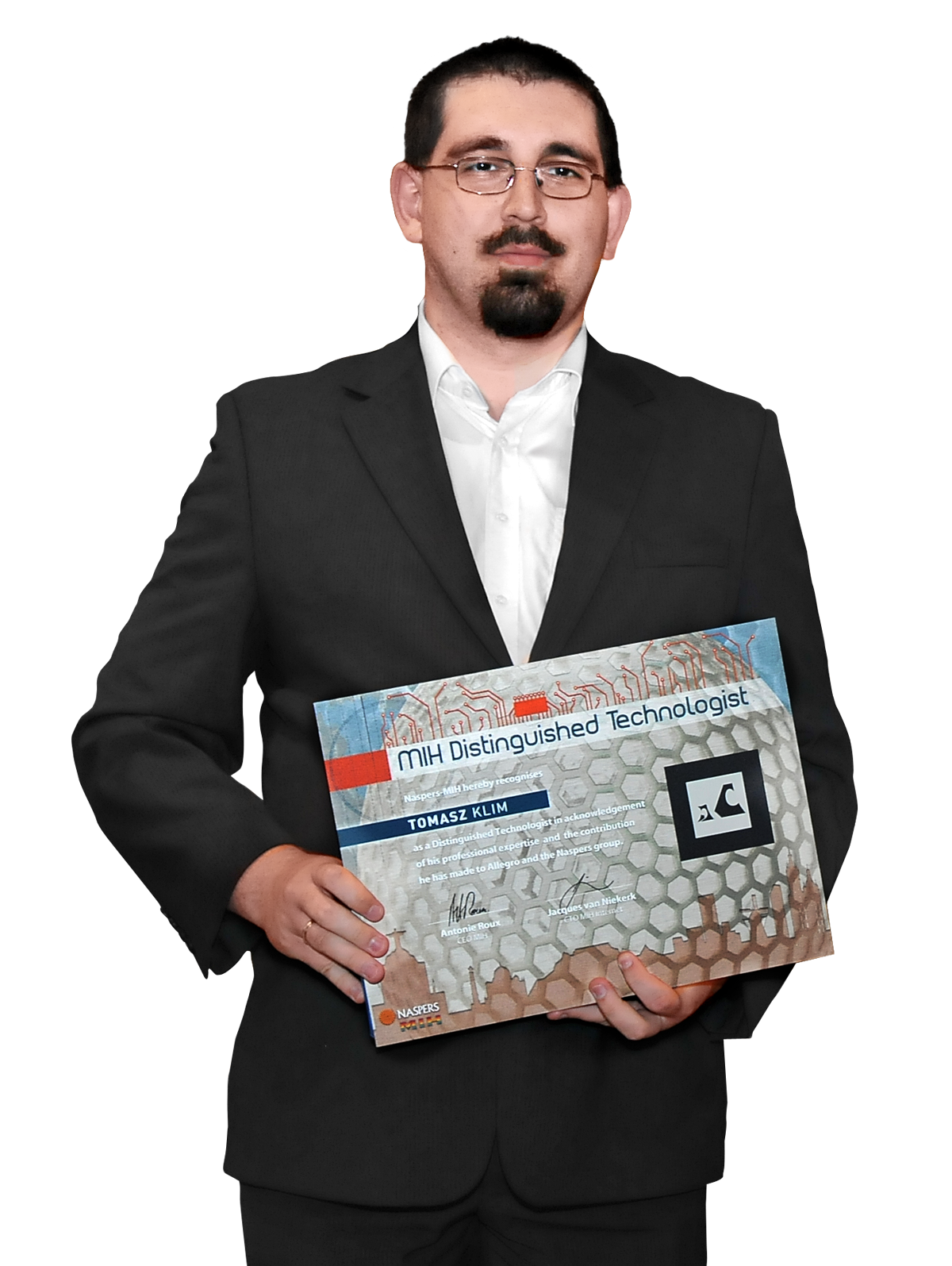
Editor-in-chief: Tomasz Klim — M.Sc. in Computer Science (Poznań University of Technology), and previously a chemistry technician with a specialization in chemical analysis, laureate of the National Chemistry Olympiad in 1996. Programmer with approximately 30 years of experience in IT security and web application scaling, including 7 years at Allegro where he was one of 11 people worldwide to receive the MIH Distinguished Technologist award from Naspers-MIH. Long-time developer of technical tools in the security and law-enforcement domain, including Drive Badger for the Brazilian market.
Contact: [email protected]
Polskie.AI Sp. z o.o. · ul. Święty Marcin 29/8 · 61-806 Poznań · Poland
NIP: 783-18-78-619 · KRS: 0001031497
How to explore this site
The site is in Polish, but the content structure follows standard academic conventions and most articles are navigable with the help of a translator. If you have a physics or chemistry background — if you know what a cross-section is, you've seen the binding energy per nucleon curve, and you understood at least half of quantum mechanics at university — you are in exactly the right place.
Start with the fuel cycle: the point where civilian power generation and military enrichment become technologically indistinguishable is explained through the nuclear fuel cycle as a system, from uranium ore to UF₆ through the centrifuge cascade. The crossover point is reactor-grade plutonium — how burnup determines isotopic ratios and why reactor-grade Pu is significantly harder to use than weapon-grade material.
For warhead design, begin with critical mass — not as a simple formula, but as a function of geometry, material density, enrichment, reflector, and initiator. Then implosion: explosive lenses, shock wave hydrodynamics, predetonation (fizzle) as the primary design constraint. Electronics splits into two paths: the actuator path covering firing set architecture, EBW detonators, and FPGA-based nanosecond sequencing; and the measurement path covering gamma spectrometry, detector calibration, and nuclear metrology in general.
As of June 2026 we have over 150 specialized calculators: critical mass, SWU and cascade balance, plutonium vector, HOB and Mach stem optimization, blast overpressure, fallout prognosis, EMP, nuclear metrology, and dozens more.
Sources and legal declaration
All content on this site is based on publicly and freely available materials: scientific publications from multiple countries, specialized databases (ENDF, JEFF, and others), open-source software (ORIP_XXI, NJOY, and others), and commercially purchased books. The editor-in-chief identified, selected, and synthesized the relevant materials; his contribution is curatorial and editorial, supported by AI-assisted research and a comprehensive understanding of the domain.
Formal declaration by Tomasz Klim: (1) I have never had access to classified information. (2) I hold no classified knowledge under Polish or any foreign law on the protection of classified information and have never applied for any government security clearance. (3) I have never served in or cooperated with any military formations, including as a civilian. (4) I am not and have never been an authorized person within the meaning of Article 129 of the Polish Penal Code or analogous provisions. (5) I have never participated in any activity described in Article 130 of the Polish Penal Code. (6) I do not disclose any knowledge covered by civil non-disclosure agreements I have signed.
Frequently asked questions
Have you actually reconstructed nuclear weapons technology?
Yes. We recovered and improved upon the nuclear technology available in open literature. This is the natural result of AI-assisted synthesis of publicly available scientific knowledge — the same process that Coster-Mullen, Hansen, Morland, and Sublette demonstrated was achievable through human effort alone, now done systematically and at scale.
How much content do you publish?
Everything is published here for free. As of June 2026: over 7,000 pages of text organized into over 300 articles, over 150 specialized calculators, and additional materials including interactive exercises and visualizations.
Are you capable of physically building a nuclear device?
We are a civilian company and are not permitted to develop anything physical — perhaps with the exception of electronics components alone. The primary barrier for any state actor is not knowledge but access to fissile materials, which are tracked at the atomic level by the IAEA and tightly controlled under international safeguards.
What kinds of cooperation can you enter into?
We cannot engage in any cooperation other than completely transparent arrangements — contracts, invoices, and payments through the official banking system only. Any other form of engagement is excluded by law and by policy.
Can you conduct specialized research on our behalf?
We are a registered journalistic company and can legally produce specialized research — but only in the form of commissioning article topics, which are then published and made freely available to all interested parties. We do not produce private reports or confidential deliverables.
Can you provide step-by-step instructions for building a nuclear weapon?
For legal reasons, we cannot publish a ready-made manual. Beyond legality: a nuclear bomb is not IKEA furniture. The relevant body of knowledge spans several thousand pages of theory across multiple scientific disciplines, and the practical path depends strictly on what fissile material you have or can realistically access. The site itself is that knowledge base — synthesized, organized, and freely available.
What is currently within technical reach?
Building working thermonuclear devices requires years of additional research beyond what is currently published. But it is within sight.
What would be the simplest nuclear device to build?
Classic uranium warheads — smaller than Little Boy, heavily improved using modern electronics and mechanics, with yields expanded up to 40–45 kt — represent the lowest technical barrier. Theoretically, we would be able to produce a working uranium warhead within 2-3 months, under the following circumstances:
- having a team, place and machinery described in this article
- client has already secured ready-to-use HEU and its parameters are known from the beginning
- client needs a laboratory-class device - without safeguards against accidental or unauthorized detonation, and without delivery phase (no integration with a missile or aircraft)
- legal, compliance, regulatory and similar phases are omitted
In other words:
- a device either assembled by hand at the detonation site, or brought eg. in a car
- rather for non-state fighter groups, than military-grade equipment, that needs to stay ready for years, waiting for a possible political decision to use it.
Also, from a state-actor perspective, this approach would be a waste of uranium: gun-type designs require a large amount of highly enriched uranium and are militarily inefficient compared to implosion designs.
What about plutonium warheads?
Miniature plutonium warheads with yields of 20–40 kt (depending on process quality), using FPGA-based electronics and hexogen-based detonators, are technically much more financially and organizationally demanding, requiring way bigger team (closer to 1000 than 40 people), but fully achievable in predictable amount of time.